Blog
Face Toner: What Does a Toner Do, and How Do You Apply It?
Face toner or Korean toner: where it comes from, what toner really does, essence vs toner, how to choose one by its ingredient list and how to apply it.
Key takeaways
- Created to remove the residue left by soda-based soaps in hard water, toner found a new role in Korea.
- In Korea, toner is called "skin" and opens the routine: it is the first layer of water, which the moisturizer then locks in.
- Essence and toner differ mainly in texture: apply them from thinnest to thickest, and one of the two is enough in a short routine.
- The top of the ingredient list tells you whether a toner hydrates, soothes or exfoliates; keep an exfoliating toner for a few evenings a week.

In March 2018, the American dermatologist Zoe Draelos answered a frequently asked question in the journal Dermatology Times. She traced the history of toner, created to remove the residue left by lye soaps in hard water. That original use has almost disappeared. Korea gave the bottle a different role: laying down a first layer of water after cleansing. Chosen well for what it contains, a toner prepares the skin for the products that follow. Discover what it does, how to choose it and how to apply it.
What toner was for: soap, hard water and pH
Toner was born from a washing problem. Most soaps have a pH of 9 to 10, according to an analysis published in 2014 by Indian dermatologists. The skin's surface, on the other hand, is acidic. Mixed with hard water, lye soaps left a sticky film on the face. Alcohol-based toner dissolved it and made washing less irritating, explains Zoe Draelos. Few people still wash this way, she adds: the product's reason for being has disappeared, but not the product.
53 out of 64
This is the number of soaps with a pH of 9 to 10, out of 64 bought in Kerala, India, and analyzed by these dermatologists; only two had the pH of skin. The authors recommend checking the pH of your cleanser, especially for sensitive or acne-prone skin. Tarun et al., 2014.
pH, however, really does matter for skin. In 2006, a Dutch cosmetics laboratory measured it in 330 people. The skin's natural pH averaged around 4.7, and skin below 5 had a barrier in better condition. Tap water, with a pH of around 8 in Europe, raised the skin's pH for up to six hours. Hence the idea of a toner that "rebalances pH" after cleansing.
6 h
This is the maximum time a tap water rinse raises the skin's pH, as measured by Dutch researchers. The pH then drops back below 5 on its own: choose a toner for what it brings, not to "rebalance" pH. Lambers et al., 2006.
Hard water, on the other hand, leaves a measurable trace. In 2018, a team from the University of Sheffield washed the skin of 80 volunteers with a common surfactant, in water of varying hardness. With hard water, more of this cleansing agent remained on the skin after rinsing. The skin then lost more water and became more irritated, especially in people with atopic eczema. Softened water limited these effects. The study confirms what Zoe Draelos described: hard water holds part of the cleanser on the skin.
Korean toner: when "skin" becomes the first hydration step
In Korea, toner is commonly called "skin", reports the daily The Korea Herald in a 2024 article on K-beauty vocabulary. The basic routine there brings together four products: "skin", "essence", "lotion" (an emulsion) and "cream". They go from the most fluid to the creamiest. In this logic, toner no longer has anything to remove. It is the first product in the routine, the one that brings the first layer of water.
Hydrating toners rely on a principle that Zoe Draelos also describes. They combine water with a humectant, a substance that draws water to the skin. The moisturizer applied next holds that water in. The MIDHA Rice Pure Toner follows this pattern. Its list opens with rice bran water, which makes up 77.5% of the formula. Next come glycerin and, further down, betaine, two humectants. The result: a light toner that rehydrates the skin after cleansing, as long as you follow with a serum or moisturizer.
Essence or toner: a difference of texture more than function
Between the two, essence is a product that the Korea Herald presents as specific to K-beauty. It recalls serum in its promises: hydration, radiance, signs of aging. But it stays lighter, almost as watery as a toner. So it goes on after toner and before serum, from most fluid to thickest. Many bottles play on both words, even calling themselves "essence toner".
The Pyunkang Yul Essence Toner is a good example. Its list has only seven ingredients and starts with astragalus root extract instead of water. Two texturizing agents, hydroxyethylcellulose and carbomer, give it a slightly denser consistency than a classic toner. Rather than looking for the right name, look at the texture: the most fluid goes first, as in our morning and evening skincare routine. In a short routine, one of the two is enough, as our article on the 10-step myth points out.
Hydrating, soothing or exfoliating: choosing your toner by its ingredient list
Under the name toner, you now find very different products. Zoe Draelos speaks of a huge diversity of formulas. The most reliable guide remains the ingredient list printed on the packaging. "Ingredients are listed in descending order of importance", notes France's National Consumer Institute. Only those present at less than 1% can appear in any order, at the end of the list. So the first names are often enough to tell whether a toner hydrates, soothes or exfoliates.
These families often overlap, because a soothing toner also hydrates. The table helps you read the top of a list, not put every bottle in a box.
| Family | At the top of the list | For which skin | When |
|---|---|---|---|
| Hydrating | Water or plant water, glycerin, betaine, hyaluronic acid (Sodium Hyaluronate) | Dry, dehydrated, and most skin types | Morning and evening |
| Soothing | Panthenol, allantoin, houttuynia (heartleaf) or centella extracts | Sensitive skin that turns red or feels tight | Morning and evening |
| Exfoliating | Salicylic acid (BHA), glycolic or lactic acid (AHA), PHA | Oily, with visible pores or blackheads | In the evening, a few times a week depending on the product page |
Exfoliating toners call for the most caution. The Anua BHA 2% Gentle Exfoliating Toner lists salicylic acid in fourth place. This BHA unclogs pores. Its product page reserves the toner for evenings, two to three times a week, on a cotton pad and away from the eye area.
For acne-prone skin, the American Academy of Dermatology (AAD) advises against astringents, toners and exfoliants that irritate. It recommends products labeled "alcohol-free". On the list, alcohol appears as "Alcohol" or "Alcohol Denat.", and the AAD also advises dry skin to avoid it.
How to apply toner: hands, cotton pad and number of layers
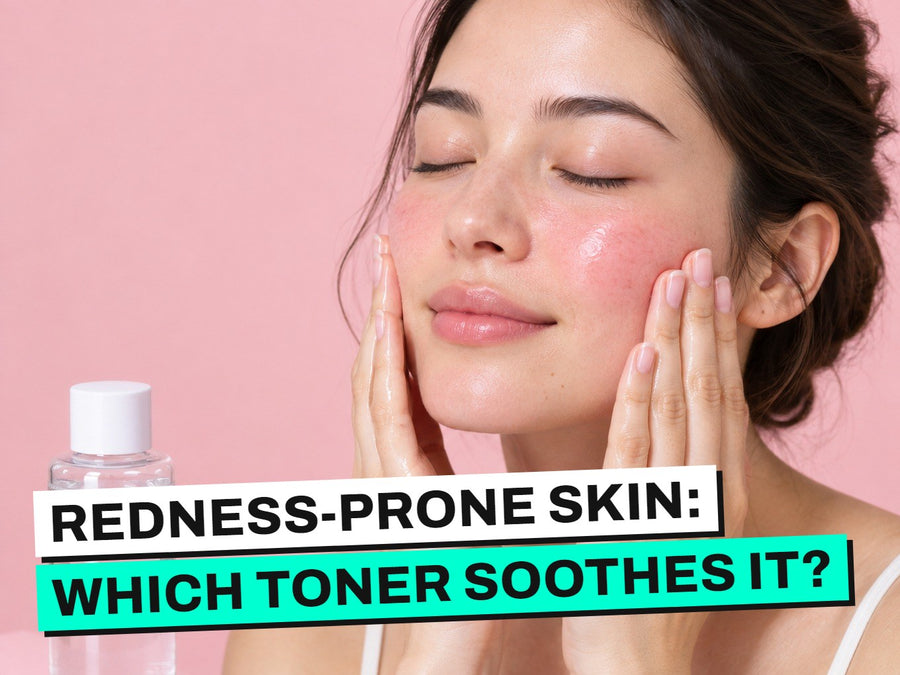
Toner goes on a clean face, right after cleansing. In the evening, it follows double cleansing. For a hydrating toner, pour a few drops into your palm, then pat your face with your fingertips. This is the method suggested on the product pages of the Pyunkang Yul Essence Toner and the MIDHA Rice Pure Toner. The cotton pad is meant for exfoliating toners, as on the Anua toner's product page. In both cases, do not rub: rubbing irritates the skin, as the AAD notes about face washing.
The "7 skin method" takes this step further: seven layers of toner, patted in one after another. Refinery29 magazine presented it in 2017, based on the co-founder of a K-beauty shop. She saw it as a way to hydrate without the heaviness of a cream. The number seven is a guide, not a rule. If you try it, use an alcohol-free hydrating toner and add the layers one by one. Stop as soon as your skin no longer absorbs, then apply moisturizer, which holds in the water you added.
After toner come serum, then moisturizer, and in the morning sunscreen last. An exfoliating toner is handled separately. The Anua toner's product page calls for caution with retinol, strong AHAs and other exfoliants. The simplest approach is to keep it for a few evenings, with no other acid or retinoid in the same routine.
At Fiveaven, we see toner as a useful step, to be chosen according to your skin. It makes the most sense for skin that feels tight after cleansing, or where tap water is hard. For oily or sensitive skin, choosing the right family matters more than the technique. The top of the list is enough to identify it, and every product page of our toners publishes its full ingredient list. If you are unsure of your skin type, our Skin Diagnosis points you in the right direction in a few questions.
Your questions
What does a toner do in your routine?
It lays down a first layer of water right after cleansing and prepares the skin for serum and moisturizer. A hydrating or soothing toner brings water and comfort to skin that feels tight after cleansing.
Toner before or after serum?
Before. Toner goes on right after cleansing, then come serum and moisturizer, from most fluid to thickest. If you use an essence, it slips in between toner and serum.
Does toner make pores less visible?
Yes, when it is well chosen. A toner for oily skin leaves skin clean and fresh, as Zoe Draelos describes. According to the AAD, clogged pores stretch and become more visible, and salicylic acid unclogs them. A BHA toner, a few evenings a week, can therefore make them less visible. Our article on enlarged pores and blackheads details the routine.
Which toner should you choose for oily skin?
A light, alcohol-free toner for everyday use and, if needed, a BHA toner a few evenings a week. The AAD advises acne-prone skin to avoid astringents and toners that irritate. They dry out the skin and can make acne more visible.
Sources
- Draelos Z. D., "Are facial toners necessary?", Dermatology Times, March 14, 2018.
- Tarun J. et al., "Evaluation of pH of Bathing Soaps and Shampoos for Skin and Hair Care", Indian Journal of Dermatology, 2014.
- Lambers H. et al., "Natural skin surface pH is on average below 5, which is beneficial for its resident flora", International Journal of Cosmetic Science, 2006.
- Danby S. G. et al., "The Effect of Water Hardness on Surfactant Deposition after Washing and Subsequent Skin Irritation in Atopic Dermatitis Patients and Healthy Control Subjects", Journal of Investigative Dermatology, 2018.
- The Korea Herald, "[Korea Quiz] Konglish terms in K-beauty", May 22, 2024.
- Chan M.-A., "The One Product You Need Before You Try The ‘7 Skin Method’", Refinery29, March 28, 2017.
- Institut national de la consommation, "La sécurité des produits cosmétiques avec la DGCCRF".
- American Academy of Dermatology, "Acne: Tips for managing".
- American Academy of Dermatology, "Dermatologists’ top tips for relieving dry skin".
- American Academy of Dermatology, "Face washing 101".
- American Academy of Dermatology, "What can treat large facial pores?".